24 December 2019

Music Consumption 2019


CDs purchased:
Digital album downloads:
CDs from LaLa swaps:
Digital singles downloaded:
# of music service subs:
Live shows attended:
04
86
-
-
50
-
30
05
76
-
-
38
-
26
06
50
44
69
63
1
36
07
64
70
28
22
1
35
08
62
65
11
38
1
44
09
101
50
7
60
1
35
10
59
12
-
22
-
35
11
73
13
-
58
-
36
12
48
12
-
37
-
28
13
58
11
-
28
-
32
14
37
12
-
39
-
44
15
43
1
-
14
-
38
16
31
2
-
17
-
38
17
14
16
-
4
2
38
18
18
10
-
5
2
40
19
34
12
-
1
3
45

Compared to last year, not that much changed. The biggest change the addition of yet another music service. Qobuz has joined Spotify and TIDAL on my list (and I've added a new line to the annual table to reflect my music subscription habits, since they now account for the majority of my recorded music spending). This is mostly because I'm an audiophile nerd and really appreciate that TIDAL and Qobuz bring lossless streaming to me (higher quality audio than Spotify, essentially), and both integrate with Roon, which is the music management software that I adore. This brings my monthly music subscription bill to $50/mo. or $600/yr. As I predicted 20 years ago, the music industry is making much more money from me today than they did at the turn of the century (particularly when you consider that there's no retailer taking 50% off the top).

Surprise, surprise, my CD purchasing is up! But it's not quite what it seems. Now that CDs have become so unpopular, the prices have plummeted, which means I find I'm picking up used CDs to fill gaps in my catalog or to "upgrade" from old mp3 from my long-gone eMusic subscription days. About a dozen of those are classical CDs I picked up for a couple dollars each. Two are obscure albums that are not available on the major streaming services (one from Ida, one from Pooka). And 11 are the Kate Bush reissues that came out this year.

So, if we're talking about *new* CDs, that number continues dwindling for me. But I still like buying the albums that I really like. But in recent years, that means buying a lossless digital download, most often from Bandcamp, rather than buying a CD. Now that my music collection is all ripped to hard drive (with multiple backups, just in case), CDs are just clutter. Plus, artists generally get to keep much more of the overall take on a site like Bandcamp than they would for CD sales that run through their distributor/label.

Finally, in something of a surprise, it looks like I hit an all-time high for live music this year. Not exactly sure how that happened, but that's the subject for a different blog post, coming soon.

2019 in Books


In 2019, I read 47 books. At least that's what Goodreads tells me. And yes, one was Tolstoy's Anna Karenina, which I did not like. That's a lot of books and partly answers the question, "what have you been doing now that you're not working?" Of those books:
  • 17 were non-fiction (36%)
  • 22 were sci-fi or fantasy (47%)
  • 5 were re-reads from my youth (10%)
There wasn't a single book that jumped out as my favorite or one that I would universally recommend. Nevertheless, here are a few that I enjoyed: 
  • in the non-fiction category, Charles Mann's The Wizard and The Prophet taught me about the history of science and made me significantly better informed about trends in energy, food, water, and climate change. Mann is among my favorite non-fiction authors (I also listened to the audiobook of 1491 this year, and am listening to the audiobook of 1493 right now); if you like Jared Diamond (of Guns, Germs, and Steel fame), you're likely to enjoy Mann's books;
  • in the fantasy category, Erin Morgenstern's The Night Circus was my favorite, creating a magical world with language that reminded me of Neil Gaiman and David Mitchell, without being quite like either of them (I also read and enjoyed her new book, The Starless Sea, but not as much as The Night Circus); 
  • another fantasy book I would recommend whole-heartedly is The Rook by Daniel O'Malley (ignore the television adaptation), which is basically Men In Black set in the UK with a female protagonist who happens to have amnesia; 
  • in the sci-fi category, I especially enjoyed The Murderbot Diaries by Martha Wells and Player of Games by Iain Banks, both of which are facially interested in artificial intelligence and its limits, but really illuminate human society and what ties it together;
  • and last, but not least, a strong recommendation for The Light Source, the first novel by my friend Kim Magowan, weaving from multiple POVs over the span of decades the story of a group of friends who revolve around two interesting women. 

23 November 2019

Wine Tasting: Age on Wine


Older wines are generally thought to be better than young wines. But why? What difference does the passing of years make? Well, one way to answer that would be to taste several wines, pairing their newer vintages with old. I last did a tasting like this in 2012, so we were overdue. Thanks to the amazing inventory of K&L Wines, I was able to gather these four paired wines last week, rather than cellaring them myself for 21 years.

What did we learn? Well, I thought the two bottles from Bordeaux, 21 years apart, told the clearest story. The older wine drank as a well-integrated experience, with tannins, fruit, green pepper, and lots of earthy characteristics, all coming together beautifully. Its younger sibling had a lot more of some of these (tannin, fruit), a lot less of others (earthy characteristics), but presented with much less integration, almost sequentially. Time smooths off the tannic pucker, while (hopefully) bringing initially unbalanced characteristics into balance. At least, that seems to be the idea where wines are built to age. Most wines, especially at prices under $40, are not designed to age, so how those turn out is a different question...

Thanks to all who joined us! What we had below, with my favorites in bold, as usual.

  1. 1994 Marqués de Murrieta Ygay Reserva Rioja ($45): made mostly of Tempranillo grapes, from one of the oldest wine producers in Rioja (1852!), this wine split the crowd, with many put off by its boldly sour finish. Although wines from Rioja are meant for long aging (especially the "Reserva" and "Gran Reserva" wines), I thought the imbalance on the finish suggested it was maybe a little over the hill. I still liked it, however, but can't really recommend it at $45/bottle. 
  2. 2015 Marqués de Murrieta "Finca Ygay" Reserva Rioja ($24): So different, lighter, higher toned, more like what most people expect from a Spanish red. And a good value. But less interesting than its older sibling. 80% Tempranillo with 12% Graciano, 6% Mazuelo and 2% Garnacha, a little more Graciano and Mazuelo, produced with grapes from a diversity of the 30 different plots within the estate. Fermented in stainless steel and matured in American oak barrels for 18 months. 
  3. 1995 Coufran, Haut Medoc ($35): Ah, Bordeaux, where the reds are built to age, and this bottle shows why. Unlike its much younger sibling, this wine delivered a well-integrated experience, with fruit, tannin, green bell pepper, and earthy secondary characteristics all happening together, without any one aspect dominating. This wine (which probably retailed for under $20 on release) is in its prime drinking years now, 24 years later. A great wine for roast beef! 85% merlot, 15% cabernet sauvignon.  
  4. 2016 Coufran, Haut-Médoc ($19): Same wine as #3, but 21 years younger. And, relatively speaking, a complete mess. Not bad, but dominated by tannin and fruit and oak, which come on sequentially, rather than as an integrated whole. When compared to #2 today, this wine loses the value contest. But in 20 more years, it's much harder to say which one I'd prefer. Lesson: Bordeaux red wine often requires age to really display what makes it so special. 
  5. 2011 Vincent Paris "Granit 30" Cornas ($40): from the Northern Rhone in France, this syrah-based wine from a young upstart wine-maker shows that well-made wines (and wine-makers) don't need 20 years to mature. I thought this was excellent and drinking perfectly, only 8 years on, with smooth tannins and well-integrated fruit, also showing secondary characteristics. I'm buying a couple more. 
  6. 2017 Vincent Paris "Granit 30" Cornas ($30): only six years younger, and still quite nice, but a great illustration of how even a few years can pull a wine together. But if you have the patience, you can save $10 by buying now and cellaring it for 6 years yourself! I might...
  7. 2003 Turley "Pesenti" Paso Robles Zinfandel ($35): one of the early vineyards from the early champions of single-vineyard Zins from Paso Robles. Turley has a mixed reputation for aging well (and thus can over time fall, rather than rise, in price). But I thought this 2003 was lovely. Despite the 16% alcohol, this didn't come across as sweet or jammy, but instead had great depth, with lots of secondary leather and earthy notes. In fact, tasted blind, I would not have guessed this was a Zin at all. Great value at this price, but this was the last one K&L had. 
  8. 2017 Turley "Pesenti Vineyard" Paso Robles Zinfandel ($50): like its older sibling, this one was near 16% alcohol. But what a difference time (and a different wine-maker) can make! This one was all blackberry compote, with a rich, sweet mid-palate. I still liked it (as I like all Zins), but this was easy to spot as a big California Zin. Hard to know, but I'm guessing it's not going to mature like the 2003 has, probably thanks to the change in wine-makers altering things. 

21 October 2019

Wine tasting: Spanish Reds


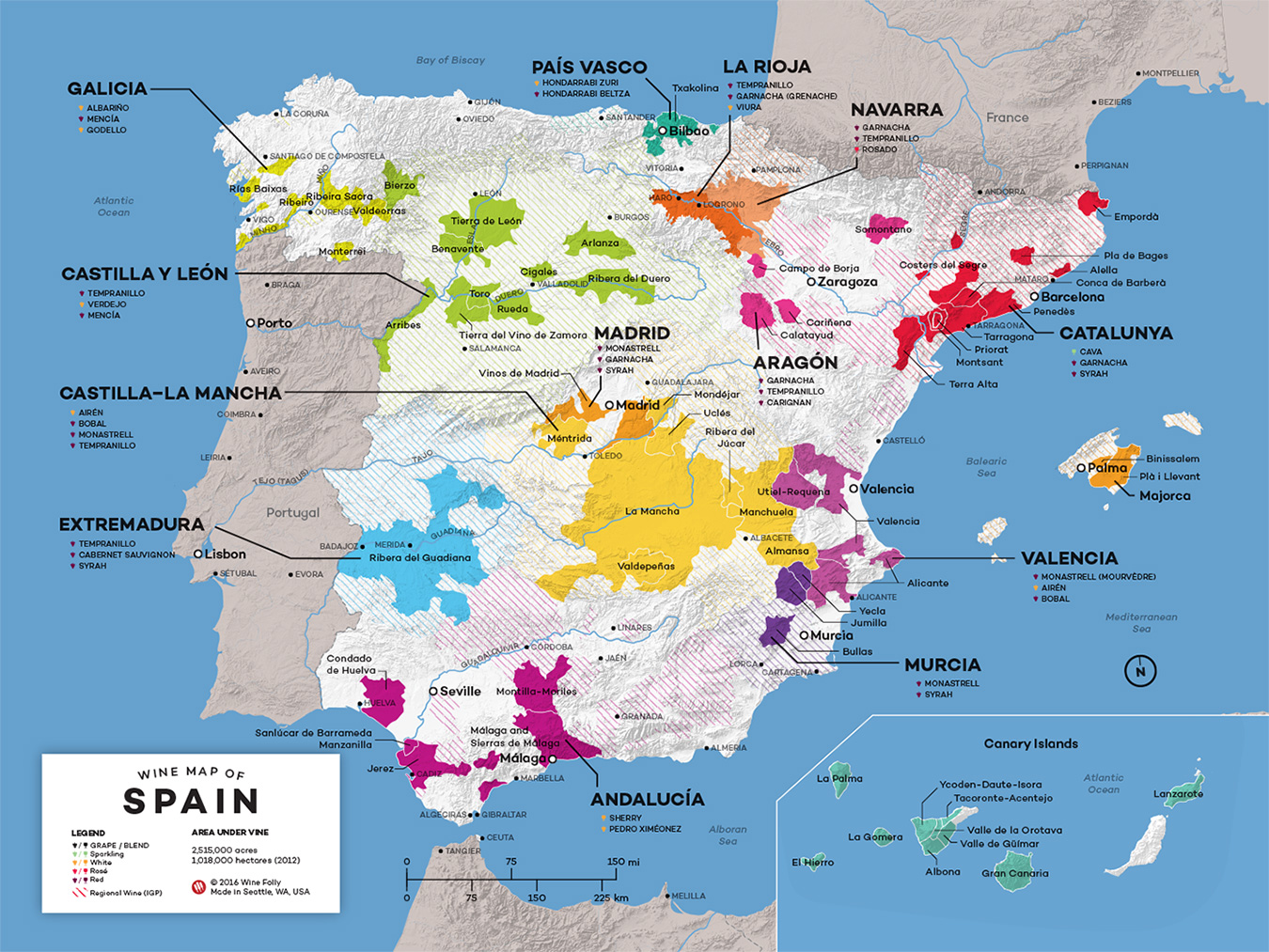
Well, that confirmed my long-standing belief that Spain is the best bet for high-value red wines. We had a reasonably good regional variation (Rioja, Ribera del Duero, Bierzo, Ribiera Sacra, Manchuela, Priorat) and a wide assortment of varietals (Tempranillo, Mencia, Garnacha, Bobal). However, given the amazing variations across Spain's many wine growing regions, we barely scratched the surface. The one common element across all of them was value. You'd be hard pressed to get bottles this good for the same price from Californian or French producers. And every one of these wines had great potential for pairing with food.

Without further ado, here's what we drank (my favorites in bold, and here's a map if it's helpful):

  1. 2017 Bodegas y Viñedos Ponce "La Estrecha" Manchuela ($27): ah, now here's a very light summer red, very easy drinking, no rough edges. Made from Bobal, a grape varietal I'd never had before. Lovely, but I wish it were about $10 less. Wine Advocate 96 pts.
  2. 2016 Castro Candaz "Finca El Curvado" Ribeira Sacra ($33): a field blend of mostly Mencía with some Merenzao (aka Trousseau), Brancellao, and Godello, this was my favorite of the night. A lighter red, reminiscent of better French cru Beaujolais wines, this was vibrant and alive in the glass. I'd be even more excited if it were a little cheaper, but I'm buying more of this. 5,000 bottles made, Wine Advocate 93 pts.
  3. 2017 Raul Perez "Ultreia St-Jacques" Mencía Bierzo ($18): A field blend of Mencia, Alicante Bouschet, Pan y Carne and some white varieties, fermented with natural yeast in old oak tanks using 100% stems and no temperature control. Of the three under-$20 bottles that we tried, this was my favorite (although I also quite like the Lesmos Rioja). Decanter 93 pts:
  4. 2016 Raul Perez La Vizcaina "El Rapolao" Bierzo ($35): another Mencia-based blend from the same wine-maker as #3, this one clearly was the "better" bottle, showing what you get when you spend more. However, while I thought this was good, I didn't think it was very distinctive or interesting. 900 bottles made, Decanter 96 pts. 
  5. 2010 Bodegas Casa Juan Señor de Lesmos Reserva Rioja ($40 in magnum): poured from the big bottle, I think this is a great example of why Rioja is my favorite red wine at the $20 price point. This is 9 years old, has some real character, would pair well with a wide range of food, and does not taste like generic supermarket wine (as do so many New World wines in this price bracket). 
  6. 2009 Bodegas Muga "Selección Especial" Reserva Rioja ($40): a nice demonstration of what you get when you spend more in Rioja, I thought this was like #5 but with more everything. Will get better with age. A blend of 70% Tempranillo, 15% Garnacho, 10% Graciano and 5% Mazuelo, 240,000 bottles produced (!!), Wine Advocate 92 pts. 
  7. 1973 Vina Berceo Gran Reserva Rioja (~$50): wow, thanks to Orion, we had a chance to try this 46 year old bottle. The wines of Rioja are known for their aging potential, especially for the Gran Reserva selections, but nearly a half century is quite a feat. While all the rough edges had been polished off from this, it still had some acid on the finish and a lovely, sherry-like quality. Still drinking quite well, which is a small miracle. 
  8. 1996 Bodegas Reyes "Teofilo Reyes" Ribera Del Duero ($35): Ribera del Duero competes with Rioja for making great reds from Tempranillo. With 23 years on the bottle, I thought this was a fantastic value at $35 (sadly, there were only a couple bottles at K&L and they've since sold out). Wine Enthusiast 94 points.
  9. 2016 Black Slate "Porrera" Priorat ($18): 50% Garnacha, 40% Cariñena and 10% Cabernet Sauvignon. This was my least favorite of the three under-$20 wines that we tried, striking me as a relatively generic "international" style red. Perfectly good, mind you, but just not terribly different from lots of other inexpensive reds. Perhaps a sign that the much-praised Priorat region is now attracting wine makers who are producing wines to appeal to the large export markets? 35,000 bottles made, Wine Advocate 92 pts.
For more details on these wines, you can also look at the tasting notes cheat sheet that I used while pouring. 

Live Music Q3 2019

Bon Iver at the Chase Center
After the torrid pace of Q2, I slowed down to a more manageable pace. This quarter brings my total to 29 for the year so far, comfortably passing my annual target of 26 shows. Mitski was a highlight, performing among the last of her shows before an announced hiatus. Other highlights in bold, per usual.
  • Mitski
  • Julia Holter
  • Better Oblivion Community Center
  • Bon Iver
  • Mountain Goats
  • Explosions in the Sky


11 August 2019

Wine Tasting: Chardonnay


We had a small crowd, but we tried a lot of wine! Thanks to those who made it.

This offered a very good overview of different approaches to Chardonnay. Overall, my conclusions were (1) stay away from California Chardonnay under $40 and (2) at almost all price points, the French offer better wine, dollar-for-dollar. That said, there are some great California Chardonnays out there, if you're willing to hunt and pay for them. And we should all be trying more Chardonnays from Burgundy, especially at lower price points. If only those labels and micro-regions weren't so darn confusing!

Here's what we drank, with my favorites in bold:

  1. 2014 La Chablisienne Chablis 1er Cru "Beauroy" $27: Chablis is an area in Burgundy that makes wonderful, relatively affordable Chardonnays, generally finished in steel tanks rather than oak barrels. La Chablisienne is the largest producer in all of Chablis, possibly accounting for up to 35% of the entire production in Chablis. I thought this bottle offered a great dose of what makes Chablis so food-friendly: lots of acid, good fruit, and mineral finish. Would be great with a dozen oysters. 
  2. 2015 Keller Estate "La Cruz Vineyard" Sonoma Coast Chardonnay $20 (Elsewhere $40): Oh, this is what gives California Chardonnay a bad name. Right out of the bottle, the overwhelming impression was buttered popcorn. This is what I'm afraid of when I see affordable California chards: too much butter, too rich, too little acid, a mystery what food you'd pair it with. 
  3. 2016 Hilliard Bruce "Venus" Sta. Rita Hills Chardonnay $25 (Elsewhere $50): A much better California offering than the Keller, I thought the description by Vinous hit the nail: “Bright citrus and floral notes are beautifully lifted throughout. Light tropical inflections develop with time in the glass, adding nuance as well as character.” At $25, not a bad value. At $50, no way. 
  4. 2014 Domaine Renaud Pouilly-Fuissé Vieilles Vignes $20: From the famous 2014 vintage, I thought this was perhaps a bit past its prime, showing as soft on the palate. Good complexity, however, and well balanced overall. As one person put it, a wine for sitting alone and crying on a cloudy day.  
  5. 2015 Domaine Auvigue Pouilly-Fuisse Solutré $20: From a wine making family dating back to 1629, made from organic grapes. The best value of the evening, in my view. For $20 at Costco, you get a real French Burgundy, showing solid balance of complex fruit and food-friendly acid finish. Maybe a little too much acid. But for $20, it outclassed the California wines under $40. 
  6. 2014 Greywacke Chardonnay Marlborough $30 (Elsewhere $40): New Zealand! Huge aromas of charred oak, but nearly no oak on the palate, which instead was dominated by tropical fruit and excellent acid on the finish. Delivered excitement over subtlety. This was one of my favorites of the evening, especially at $30. 
  7. 2013 Failla "Chuy Vineyard" Sonoma Valley Chardonnay $44: The Chuy Vineyard, planted in 1964, is located on the Sonoma side of Mount Veeder. Now here is a Chardonnay that demonstrates the promise of California. Complex, balanced, with good acid on the finish, this was the measure of any of the French wines (but at a higher price). 
  8. 2011 Domaine Bruno Colin Chassagne-Montrachet 1er Cru "La Maltroie" $35: Oh, this is why France is so hard to beat when it comes to Chardonnay. Although white Burgundies are often over $100 per bottle, even the more basic bottles like this deliver bright fruit, hints of complex baking spices, and enough acid on the finish to pair well with lots of food.
  9. 2012 Jacques Bavard Meursault $40: Another great, reasonably priced Burgundy wine, this time leaning toward the darker flavors and bigger dose of baking spices. A great introduction to the Kongsgaard, I thought, because it offered a similar style, but with a lot less intensity and complexity. 
  10. 2007 Kongsgaard Napa Valley Chardonnay $80 (current vintages $120): I put this in as a ringer, to demonstrate both what Chardonnay is capable of, and what California is capable of. As with many other varietals, Chardonnay at these prices is like a completely different wine. Much richer and more intense than any of the other wines, this offered many layers of complexity, finishing with a surprisingly powerful beam of acid, given its age. 
  11. 2012 Copain "Laureles Grade" Monterey County Chardonnay $40: So, we should have had this earlier, but I forgot that I opened it until the end of the evening. Another very strong California bottle, showing richness without too much oak. A much brighter style than Bavard or Kongsgaard. But, frankly, my palate was pretty far gone by this point...


01 August 2019

Revisiting the Music of 2000


For a recent listening club session with friends, the theme was music from the year 2000. Nineteen years ago. Before smartphones. The peak of Napster. Just after the anticlimax of Y2K. The end of the first dot com bubble (more 2000 trivia here). I was living in San Francisco, recently returned from Seattle, soon to quit working as a junior associate at a big law firm and take a research fellowship at Berkeley.

On revisiting what I was listening to that year, I was struck by the narrowness of my musical exposure: I was very focused on Americana/alt-country singer-songwriters. This is a testament to how different things were when you had to buy a CD to try something--there was a lot less trying things out. So I kept to my lane: singer-songwriters. In the era of subscription streaming music services, I can now roam much more broadly, thankfully.

My favorite albums that year were:
  • PJ Harvey, Songs from the City, Songs from the Sea
  • Joseph Arthur, Come to Where I'm From
  • Ida, Will You Find Me
  • Thievery Corporation, The Mirror Conspiracy
  • D'Angelo, Voodoo
  • Shelby Lynn, I am Shelby Lynn
  • k.d. lang, Invincible Summer
In retrospect, I would probably demote the k.d. lang, Shelby Lynn, and Joseph Arthur albums. I still like them, but none feels indispensable now. I still stand by the others, especially PJ Harvey and Ida.

But looking at the sampler CDs I made for my friends that year, I see Dar Williams, Buddy Miller, Emmylou Harris, Neko Case, Rickie Lee Jones, Eleni Mandell, Elliott Smith, Noelle Hampton, and Sarah Harmer (strong showing by the singer-songwriter axis). There's also some electronica, showing the enduring influence of 1998's Kruder & Dorfmeister album and 1999's Moby album. So my samplers included tracks from Thievery Corporation (The Mirror Conspiracy), St. Germain (Tourist), and DJ Shadow + Cut Chemist (Brainfreeze).

Stand-outs that, in retrospect, I didn't love enough (and, in several cases, I didn't even hear):
  • Grandaddy, The Sophtware Slump
  • Sigur Ros, Ágætis byrjun
  • Godspeed You! Black Emperor, Lift Your Skinny Fists Like Antennas to Heaven
  • Elliott Smith, Figure 8 (although I don't think it's as great as some of his earlier stuff)
Albums that critics think I should have loved in 2000, but I'm still not loving:
  • Radiohead, Kid A (yes, I appreciate that it's pivotal, but no, I don't find myself reaching for it)
  • Outkast, Stankonia (yes, B.O.B. is great, as is Xplosion, but about half the tracks do nothing for me, plus all the misogyny) 
  • Eminem, The Marshall Mathers LP (I missed the whole Eminem thing, and I don't think I missed much in retrospect)
  • The Avalanches, Since I Left You (an album I appreciate, and that I can't manage to like as much as I'm supposed to)
And I'm still angry that it took so long for the music industry to approach the ease-of-use and infinite inventory that Napster was already providing in 2000.